Will the Answer Engines Cite You?
Everyone is chasing AI search visibility. Almost nobody is solving the harder problem: getting the click. The data on the GEO click gap, and five things that actually earn the visit.
Everyone is chasing AI search visibility. Almost nobody is solving the harder problem: getting the click.
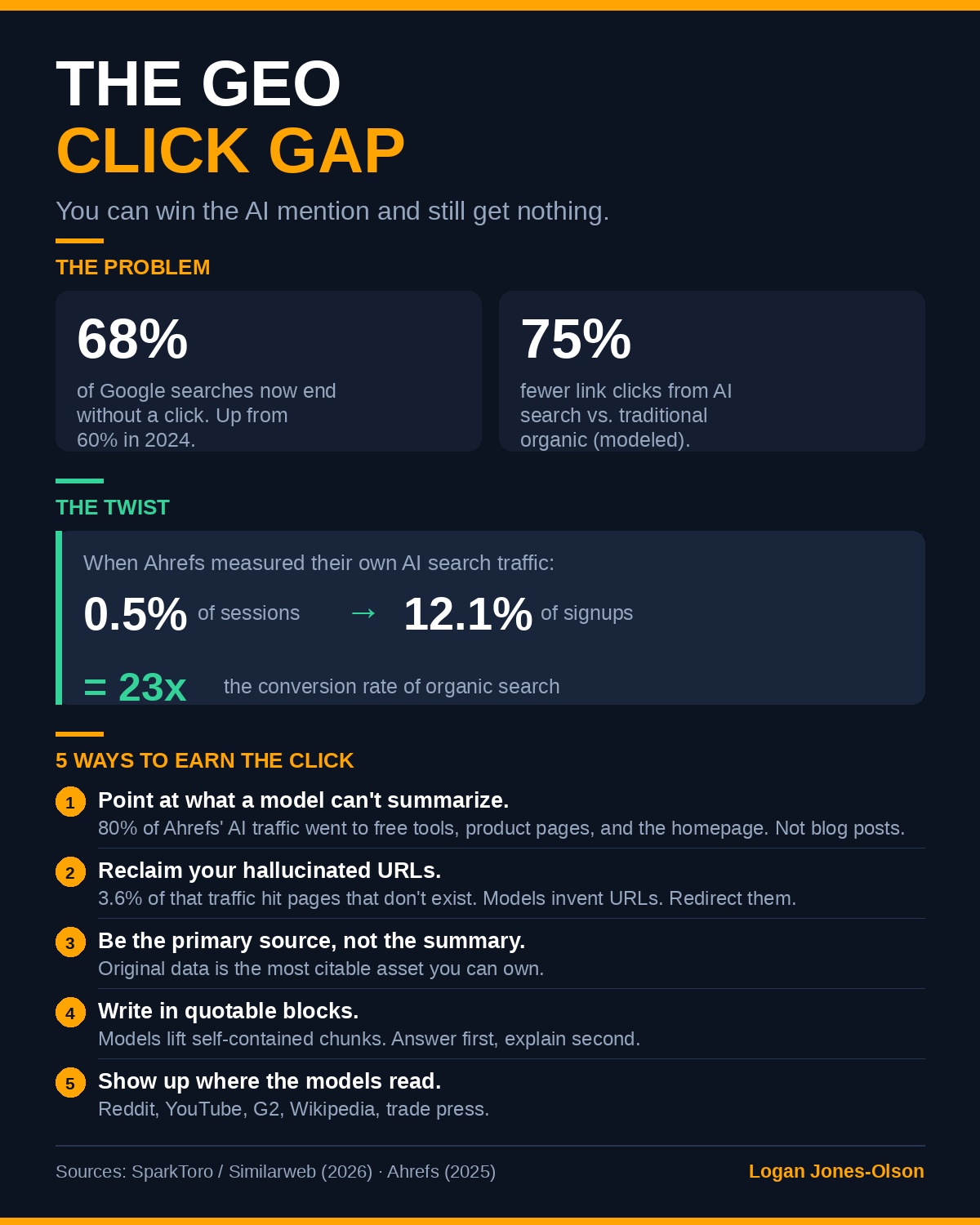
Here is the state of play in one paragraph. In the first four months of 2026, 68% of Google searches ended without a click, up from 60% in 2024, per SparkToro’s study built on Similarweb clickstream data. AI assistants send even less traffic out: Ahrefs modeled that visitors from AI search click links roughly 75% less than in traditional organic. So you can win the mention, watch a model describe your company fluently, and still get nothing.
That is the click gap, and it is the number this essay is about.
The twist that changes the math
If AI search sends so little traffic, why fight for it at all? Because the traffic it does send behaves differently.
When Ahrefs measured their own AI search traffic, it was 0.5% of sessions and 12.1% of signups. That is roughly a 23x conversion rate versus traditional organic search. One company’s data, not a law of physics, and Ahrefs is a tool company whose buyers live in exactly the channels being measured. But the pattern is showing up across the industry, and the logic behind it is sound: by the time someone clicks through from an AI answer, the assistant has already done the qualifying. The visitor arrives briefed.
Small, high intent, absolutely worth fighting for. The question is how you earn those clicks without burning a year on tactics that only earn mentions.
Five things that actually earn the click
1. Point at what a model cannot summarize for you
Over 80% of Ahrefs’ AI search traffic went to free tools, product pages, and the homepage. Not blog posts. The breakdown in their page-type study: 36.45% to free tools, 23.12% to product pages, 20.41% to the homepage.
The lesson is blunt. An assistant can summarize your article in two sentences, and it will, and the reader will never arrive. It cannot run your calculator, price your quote, or hand someone your product. Build the thing that requires the visit, then make sure the models know it exists.
2. Go reclaim your hallucinated URLs
3.6% of Ahrefs’ AI search traffic landed on pages that do not exist. The models invented the URLs. That is qualified traffic, sent by an assistant that believes in you enough to fabricate a path, hitting a 404.
The fix costs nothing: pull your server logs, find the fabricated URLs, and 301 each one to the real page it should have been. Almost nobody is doing this. It is the cheapest GEO tactic in existence.
3. Be the primary source, not the summary of one
Original data is the most citable asset you can own. SparkToro’s zero-click research gets quoted everywhere, including in this essay, because they actually ran the study. They even license reuse with linked credit, which turns every citation into distribution. That is citation engineering, and it compounds the way good backlink strategies used to, except the consumer is now a model deciding what to quote.
If you have proprietary data, publish it with your name on it. If you do not, you are one instrumented workflow away from having some.
4. Write in quotable blocks
Models lift self-contained chunks, not arguments that unfold over six paragraphs. Lead with the direct answer, then explain underneath. Keep each section able to stand alone with its numbers and its nouns intact. Stripe’s documentation is the standard here: short, structured, each piece complete in itself.
You are reading the format right now. This essay practices what it argues, on purpose, because a piece about earning citations should be built to be cited.
5. Show up where the models read
Reddit, YouTube, G2, Wikipedia, trade press. Citations you earn off your own site feed back into how models describe you. Your entity, the stable cluster of facts a model associates with your name, is built across the whole corpus, not just your domain. A company that only publishes on its own blog is legible in exactly one place.
One honest note on llms.txt
Everyone is selling llms.txt right now. As of mid-2026, no major AI vendor has publicly confirmed that their search crawlers consume it. It is genuinely useful for coding agents and IDE tools, and it costs little to maintain, which is why this site has one. It is not the silver bullet it is being marketed as. Spend accordingly.
The discipline underneath
The fundamentals have not changed. The surface has. Discovery is moving from ten blue links to one synthesized answer, and the response is the same discipline that has always separated operators from spectators: measure whether you are cited, build things worth clicking, and make sure a machine can quote you accurately.
I spent eight years at Nav learning that a channel you cannot measure is a channel you cannot manage, and rebuilt attribution at Linqto when 80% of conversions claimed to be “direct.” AI answer engines are the newest unmeasured channel, and they will reward the same people the last one did: the ones who instrument first.
Sources: SparkToro, “In 2026, Less than One Third of Google Searches Still Send a Click” (Rand Fishkin, June 2026, Similarweb data): sparktoro.com · Ahrefs, “Does AI Search Traffic Convert Better Than Traditional Search?” (the 0.5% / 12.1% / 23x data and the 75% click modeling): ahrefs.com · Ahrefs, “80% of Our AI Search Traffic Goes to Our Homepage, Product Pages, and Free Tools” (page-type breakdown and the 3.6% hallucinated-URL finding): ahrefs.com · Stripe documentation, as a structure reference: docs.stripe.com · Similarweb’s GEO and zero-click research hub: similarweb.com
If you want to see this discipline applied to a revenue number, read the case studies, or get in touch.